
10 Questions to Ask a Contractor Before a Major Home Renovation
Hiring a contractor for a major renovation is different from hiring one for a kitchen or bathroom remodel. At this scale, you’re trusting someone to manage hundreds of decisions across design, budget, procurement, scheduling, and construction often over the course of a year or more. Materials get delayed, conditions are uncovered behind walls, designs evolve, and dozens of trades have to work around one another.
The questions you ask before signing a contract should reflect that complexity. Here are ten questions built for that scale, with what a real answer should sound like.
1. Can I verify your license, bond, and insurance directly?
A contractor should hand this over without hesitation. In California, you can confirm an active license, its classification, and any disciplinary history yourself at cslb.ca.gov. Ask for proof of general liability and workers' compensation coverage as documents, not just a verbal assurance.
2. How do you build your estimate, and how does it get more accurate over time?
An estimate prepared early in design will naturally contain more assumptions than a construction-ready budget. What matters is whether your contractor has a clear process for replacing those assumptions with real numbers as the project develops.
Ask what the initial estimate is based on. Is it square-foot pricing, historical project data, preliminary drawings, or actual subcontractor bids? Then ask how often the budget is updated as drawings, specifications, and finish selections become more defined.
A good estimating process should become progressively more detailed. Early budgets help establish feasibility and identify major cost drivers. As the drawings develop, quantities can be confirmed, scopes clarified, and subcontractor pricing incorporated. By the time construction begins, there should be far fewer allowances and assumptions left in the budget.
Where your estimate starts depends on where your project is. The more developed the plans and selections, the more detailed the estimate can be. Here’s how our estimates typically progress as more project details are finalized:

Three-stage construction estimating process showing how a renovation budget progresses from a rough order of magnitude to a refined estimate and detailed bid as plans, specifications, and material selections become more developed.
3. How are design changes priced once construction has started?
Even with a well-developed set of plans, it’s normal for ideas to evolve once you can see the space taking shape. You may want to change a finish, move a fixture, revise a built-in, or rethink a detail once you experience it at full scale.
Before construction begins, ask your contractor how those changes are priced and approved. A design change can affect more than the item being changed—it may require additional labor, materials, revisions to completed work, or adjustments to other trades and the project schedule.
A clear change order process should show you the cost and potential schedule impact before the additional work moves forward, so you can make an informed decision rather than discovering the impact on your next invoice.
4. What happens if we need to value-engineer part of the project?
Value engineering shouldn’t simply mean choosing cheaper materials or cutting scope. Done well, it’s a collaborative process of finding smarter ways to achieve the design intent while bringing cost, scope, and priorities back into alignment.
Ask your contractor how they approach value engineering and when those conversations happen. A good contractor should be able to identify alternatives, explain the cost and schedule implications of each, and work with your architect or interior designer to understand where substitutions can be made without compromising the parts of the project that matter most.
5. How do you procure long-lead items like custom millwork or imported materials?
Stone, specialty windows, and custom cabinetry can take months to arrive. A contractor who's thought about this will describe when these get ordered relative to the construction schedule, and what happens if a lead time shifts. This question alone tends to separate contractors who plan from those who react
How we'd answer this: Long-lead items get identified during pre-construction, before the schedule depends on them, and tracked against the build timeline so ordering happens ahead of when it's needed.
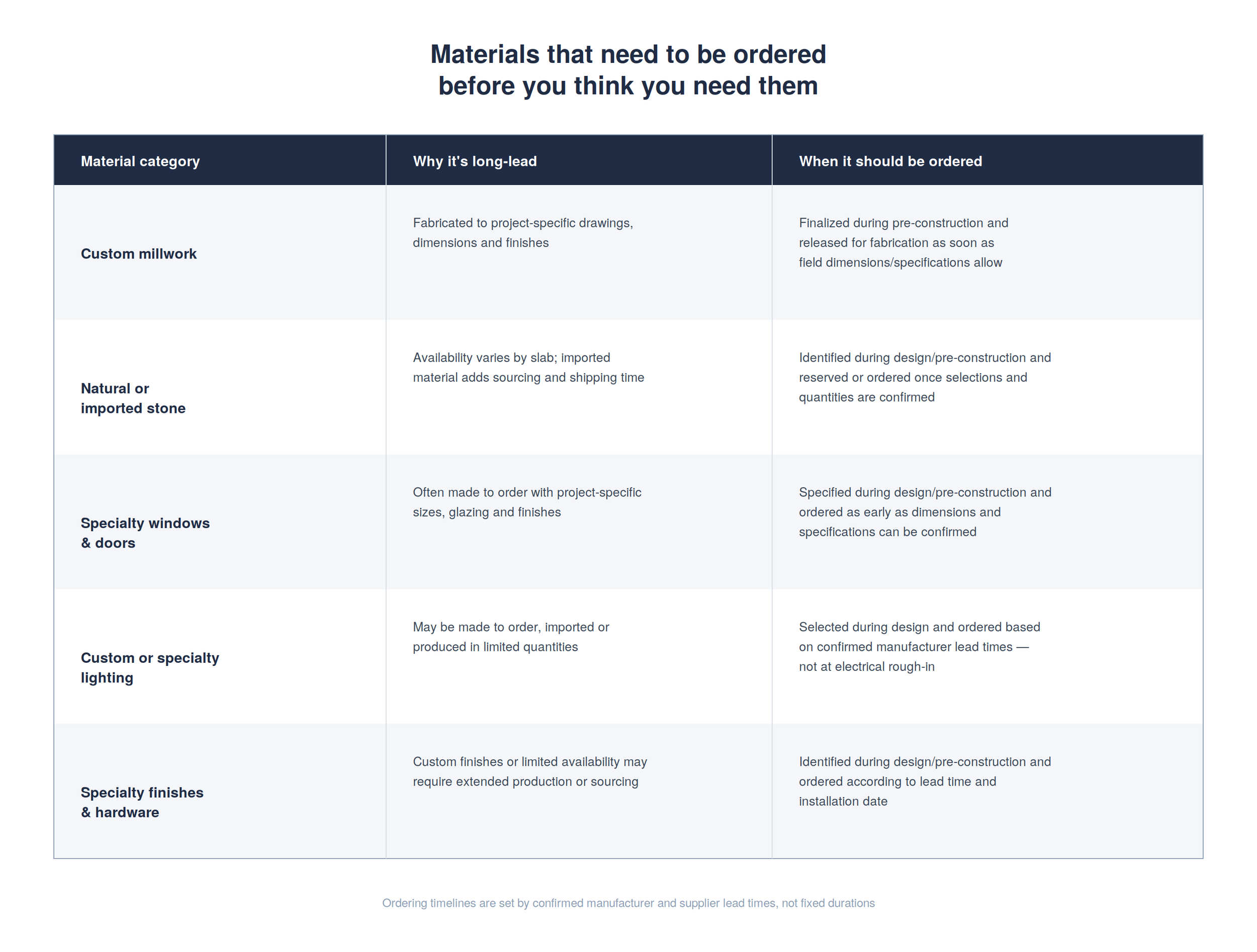
Long-lead material guide for major home renovations showing when to plan and order custom millwork, natural or imported stone, specialty windows and doors, custom lighting, and specialty finishes and hardware.
6. Who is my single point of contact during construction?
Clear ownership becomes especially important when schedules shift, selections are due, or an issue arises in the field. Without a defined point of contact, important information can easily get lost between teams. Before hiring a contractor, ask who will actually manage your project day to day. Will you have a dedicated project manager? How often will they communicate with you? And if something needs a decision, who is responsible for bringing it to your attention?
How we’d answer this: You’ll have a dedicated Project Manager who serves as your primary point of contact throughout construction, supported by an on-site Superintendent and the broader HWA team. Your PM keeps communication organized, tracks decisions and open items, and makes sure you always know who is accountable for the next step.
7. How do you coordinate with my architect or interior designer?
On a major renovation, your contractor will make hundreds of decisions that intersect with the architect and interior designer’s work. A detail that looks straightforward on paper may affect framing, electrical, plumbing, millwork, or another trade once construction begins.
Ask who is responsible for communicating with the design team, how often they meet, and how questions, revisions, and approvals are documented. You shouldn’t have to act as the messenger between your contractor, architect, and designer.
8. What happens if we run into unforeseen conditions once walls are opened?
Even with thorough pre-construction planning, there are some conditions you simply cannot identify until demolition begins. Older homes can reveal outdated wiring, undocumented plumbing, structural conditions, water damage, hazardous materials, or previous work that doesn’t match the existing drawings.
These discoveries can affect both the project timeline and budget. What matters is having a clear process for identifying the issue, understanding its impact, and determining the right path forward before additional work proceeds.
HWA CASE STUDY: What We Found Behind the Walls
On a recent interior renovation, demolition exposed materials that required additional environmental testing. Once the walls were opened, our team paused work in the affected area and coordinated the required asbestos testing and AQMD compliance process before construction could continue.
This was not a condition that could have been fully identified during the initial walkthrough because the affected materials were concealed behind the existing finishes.
The discovery required additional testing, coordination, and remediation, resulting in added time and cost to the project.
The takeaway: No contractor can guarantee what is behind a finished wall. A strong pre-construction process helps reduce risk, but unforeseen conditions are an inherent part of renovating existing homes. The difference is how those discoveries are managed.
9. Can I see a project similar in scope to mine, and speak with that homeowner?
Ask for a project close to your size and complexity, not just their best-looking one. When you talk to that homeowner, ask about cost communication during the project, not just the finished result.
10. What's your realistic timeline, and what could change it?
A timeline that sounds too clean usually is. A grounded answer names specific risks: permitting delays, long-lead materials, or structural surprises common to homes of a certain age or condition, and how those get communicated if they happen.
Quick Reference
Can I verify your license, bond, and insurance directly?
How do you build your estimate, and how does it get more accurate over time?
How are design changes priced once construction has started?
What happens if we need to value-engineer part of the project?
How do you procure long-lead items like custom millwork or imported materials?
Who is my single point of contact during construction?
How do you coordinate with my architect or interior designer?
What happens if we run into unforeseen conditions once walls are opened?
Can I see a project similar in scope to mine, and speak with that homeowner?
What's your realistic timeline, and what could change it?
Bring this list into your first conversation with any contractor you're considering. The answers will tell you more about how the project will actually run than any portfolio can. [Schedule a consultation]and we'll walk you through ours.
